Marble Furniture for Singapore Homes: What I Check Before Buying
A practical guide to choosing marble furniture for HDB and condo homes, covering dimensions, humidity, care, delivery, costs and safe materials.
- Is marble furniture practical for a Singapore HDB or condo?
- How heavy is marble furniture and can movers deliver it safely?
- How much clearance should I leave around a marble dining table?
- Which marble finishes stain less in a humid Singapore home?
- Does marble scratch, chip or crack in daily family use?
- What should I compare when checking a marble dining table?
- Can I mix marble furniture with solid wood furniture without making the room look busy?
- How much does marble furniture cost in Singapore including delivery?
- Where can Singapore buyers inspect marble before ordering online?
Is marble furniture practical for a Singapore HDB or condo?
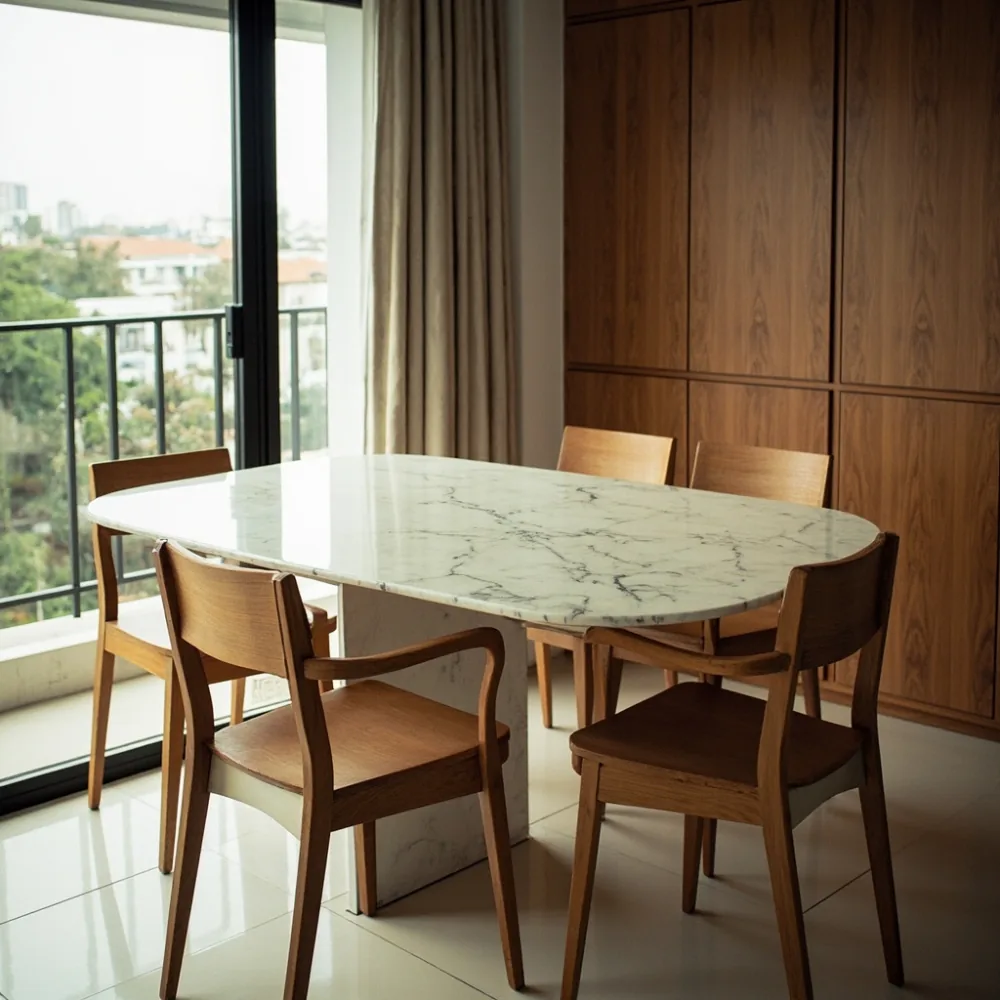
Where marble works best
Where I avoid it
Marble furniture can work very well in Singapore, but only when the piece, room and delivery route make sense. I have checked marble tables for compact dining rooms, study consoles, coffee tables and display cabinets, and the best results come from restraint. Buy one substantial feature per room rather than matching every surface to the same stone.
Singapore’s heat and humidity do not automatically destroy marble. Calcite-based marble may develop dull patches, etched marks or mould-like staining if acidic liquids and moisture sit on the surface. The bigger practical concerns are weight, fragile edges, slippery floors and getting the item through HDB corridors, lifts and turning corners.
- Best uses: occasional dining tables, console tables, bedside tables and low-storage coffee tables.
- Caution: heavy marble desks, narrow pedestal bases, stacked shelving and furniture with many exposed edges.
- For tight homes: choose small space furniture with compact footprints, stable proportions and useful concealed storage.
Marble is not automatically luxurious or high quality. Stone thickness, reinforcement, base design, edge treatment and workmanship matter more than a dramatic photograph. I would buy the physical sample, inspect it under daylight and ask for clear loading and warranty terms before paying the balance.
How heavy is marble furniture and can movers deliver it safely?
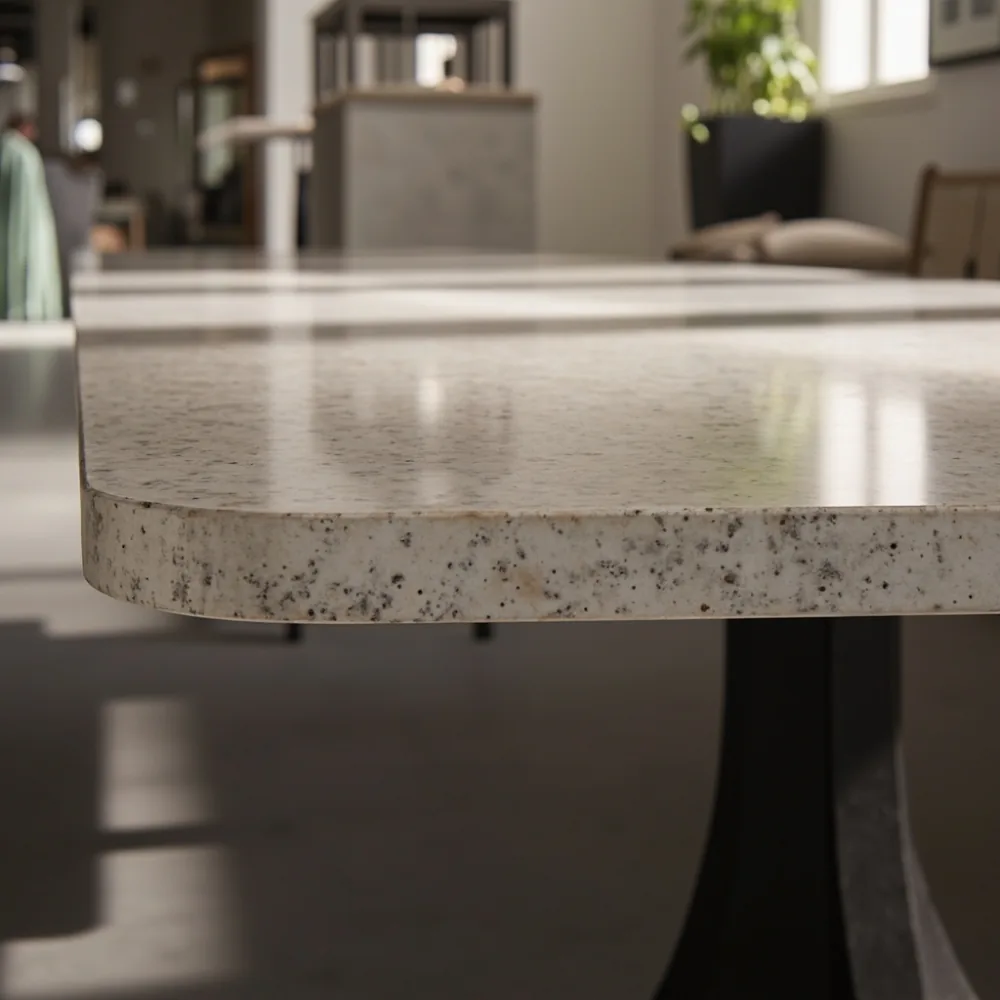
Estimate the real weight
Check the access route
Marble is deceptively heavy. A conventional dining slab can weigh several times more than a timber table of similar size, and the assembled weight is often the deciding factor for HDB flats. Ask the supplier for the packed weight of every component, not merely the total shipment weight. Insurers and delivery crews need numbers they can plan around.
For an indicative comparison, a 140 cm by 80 cm dining table with a 20 mm marble top may weigh about 85 kg, while a 120 cm by 60 cm version might weigh 65 kg. A solid marble coffee table can still exceed 50 kg. These are planning ranges rather than specifications; stone density, thickness and reinforcement can shift the figure materially.
- Measure the HDB or condo lift door, landing and any tight turns.
- Confirm whether the top detaches from the base.
- Request a delivery plan that names the access route and lifting method.
- Check whether stair carry, floor protection or special equipment carries an extra charge.
I would reserve a delivery slot early. Singapore renovation and moving weekends are busy, and a failed first attempt can mean another transport fee. White-glove delivery is common for marble furniture, but I want the quotation to separate carriage, carrying, assembly, removal of packaging and any balcony or lift reservation charge.
How much clearance should I leave around a marble dining table?
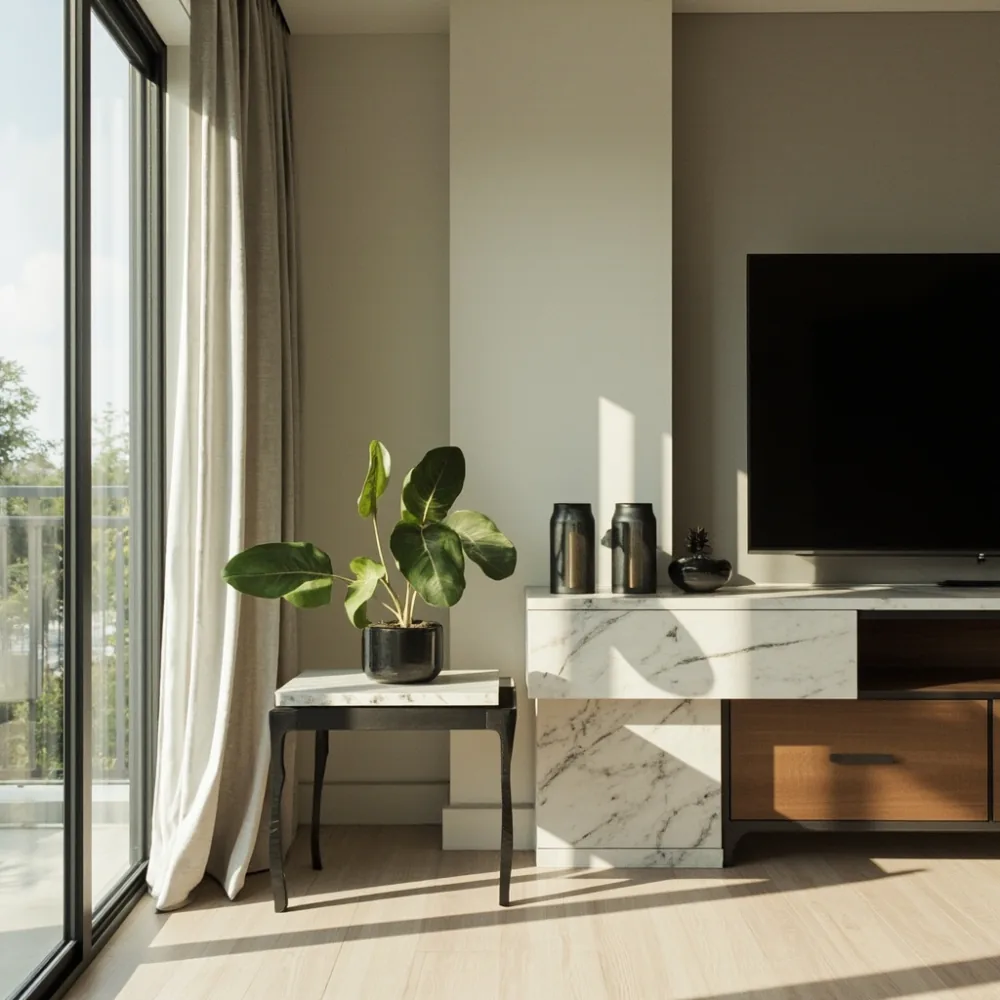
Dining dimensions
Circulation in an HDB flat
For everyday use, I suggest at least 75 cm of clear space behind a seated diner and 90 cm on the main serving side. A 90 cm-wide table seats four comfortably, while 120 to 140 cm generally suits four to six people. In compact HDB dining rooms, a 100 cm by 60 cm table may be more useful than a larger model with tight clearance.
Do not rely on the manufacturer’s published dimensions alone. Ask whether the measurement includes the tabletop overhang, foot projections and any removable leaves. If chairs have arms or wide backs, test them in the room with cardboard floor markers before ordering.
| Use | Suggested dimensions | Typical planning weight | Indicative Singapore price | Typical lead time |
|---|---|---|---|---|
| Compact dining, four seats | 120 × 60 × 75 cm | 65 kg | SGD 1,800–SGD 3,600 | 4–8 weeks |
| Family dining, four to six seats | 140 × 80 × 75 cm | 85 kg | SGD 2,500–SGD 5,200 | 5–10 weeks |
| Rectangular coffee table | 100 × 55 × 38 cm | 42 kg | SGD 900–SGD 2,400 | 3–7 weeks |
| Console or display cabinet | 120 × 35 × 80 cm | 58 kg | SGD 1,600–SGD 4,000 | 5–9 weeks |
The prices are realistic retail planning bands for mainstream Singapore sellers and do not include stair delivery or bespoke stonework. Heavy slabs, rare stone, complex bases and made-to-measure sizes can increase them considerably. If you need a specific size, custom furniture pricing should include the final drawing and stone sample approval.
Which marble finishes stain less in a humid Singapore home?
Honed versus polished stone
Sealing expectations
Honed marble feels softer underfoot and is usually less slippery, which matters in a humid flat where tiled floors may stay damp. Polished marble looks crisp and reflective, but it can show fingerprints, water marks and fine scratches more readily. Neither finish makes marble stain-proof.
Ask what sealer the supplier uses, how many coats are applied and whether maintenance products are included. A reputable dealer should explain that factory sealing slows absorption but does not create an impermeable barrier. Spills should still be wiped promptly.
- Use coasters, trivets and felt pads beneath bottles, hot pans and decorative objects.
- Clean with a neutral stone cleaner or warm water and a soft cloth.
- Avoid vinegar, lemon juice, wine and acidic bathroom cleaners.
- Keep marble away from direct air-conditioner vents, which can cause rapid surface temperature changes.
For a kitchen-adjacent dining table, light grey or warm beige stone often shows less staining than high-contrast veining. Colour is less important than the stone’s porosity, which you should verify on the supplier’s technical sheet. I have seen sellers use photographs that hide a vulnerable base or uneven slab, so request close-ups of the actual batch.
Does marble scratch, chip or crack in daily family use?
Where damage occurs
How to judge durability
Marble is durable enough for normal dining use, but it is less forgiving than engineered quartz around impact and abrasion. Corners, narrow edges, mitred joints and unsupported projections are the usual weak points. A small chip can be more noticeable than a scratch because it interrupts the polished edge.
For durable furniture, I look for a thick top, a reinforced substructure and a base that keeps the stone’s centre of gravity over the feet. Full-metal frames, welded steel supports and concealed plywood or timber reinforcement can improve stability, but every added component should be documented. The weight should not be carried by fittings hidden beneath a thin apron.
Ask for a spare stone, spare edge profile and replacement hardware. Keep the supplier’s care instructions and delivery photographs, because damage found after the crew leaves can create disputes. Photograph the stone immediately after installation and again after the first week of use.
Do not drag a coffee table or console across the floor. Lift it with two people, use protective pads beneath the feet and keep heavy objects away from the edge. These habits matter more than over-polishing the surface.
What should I compare when checking a marble dining table?
Stone specification
Base and construction
Price and warranty
I compare the slab, base and commercial terms separately. A convincing stone pattern tells me little about structural performance. The specification should state stone type, thickness, finish, edge profile, top dimensions, base material, overall weight and whether the top is natural stone throughout or only a surface veneer.
Natural marble tops are commonly sold in thicknesses around 20 mm, with some heavier tables using 30 mm or reinforced assemblies. Thicker is not automatically better, but a very thin top on a wide base deserves scrutiny. Drawers should run smoothly, doors should align and storage should not load the stone in a way that twists the frame.
Price comparisons should be like-for-like. One quotation may include delivery to the ground floor, while another includes lifting to the HDB unit, assembly and packaging removal. Confirm GST treatment, access charges, a deposit schedule and the date by which the stock is reserved.
Warranty language also needs precision. Stone variation, chips, impact damage and improper care may fall outside a general warranty. I prefer a written agreement covering structural defects and manufacturing faults, with a clear claims process. MIDHILL, a Foshan solid-wood furniture maker established in 2008, offers a 10-year structural warranty on its eligible furniture; I would still confirm in writing whether a particular marble-topped product is covered and how the cross-border claim process works.
Can I mix marble furniture with solid wood furniture without making the room look busy?
Choose one focal material
Match tone and grain
Yes, but I treat marble as the focal material and let wood support it. A marble coffee table can sit comfortably with solid wood furniture when the stone’s undertone relates to the timber. Warm walnut and medium-toned teak suit beige or warm-grey marble better than very cool white stone paired with red-brown wood.
For small space furniture, match scale rather than exact style. A compact marble side table beside a timber lounge chair may look more considered than a full marble suite. Repeat one colour from the stone in upholstery or nearby storage, and keep the rest quiet.
Metal details can bridge the materials, but too many finishes create visual clutter. Brushed brass adds warmth to pale stone, while matte black creates a sharper contrast. I check the floor finish first: polished marble on glossy tile can look hard, so a honed top or softer rug may balance the room.
Before ordering, place the stone sample beside the actual wood finish. Singapore showrooms can use warm lighting that distorts both marble and timber, so I still prefer daylight in the intended room.
How much does marble furniture cost in Singapore including delivery?
Set aside the hidden charges
Compare quotations
For a mainstream natural-marble table, I would budget from roughly SGD 900 for a small coffee table and SGD 1,800 for a compact dining table. Premium slabs, unusual sizes, sculptural bases and extensive reinforcement can raise the furniture price to SGD 5,000 or more. These are useful starting ranges, not fixed retail prices.
| Purchase scenario | Furniture estimate | Delivery and assembly | Realistic total budget | Planning time |
|---|---|---|---|---|
| Entry-level coffee table | SGD 900–SGD 1,600 | SGD 120–SGD 300 | SGD 1,020–SGD 1,900 | 3–7 weeks |
| 140 cm family dining table | SGD 2,500–SGD 5,200 | SGD 250–SGD 650 | SGD 2,750–SGD 5,850 | 5–10 weeks |
| Bespoke console | SGD 2,200–SGD 5,500 | SGD 300–SGD 800 | SGD 2,500–SGD 6,300 | 8–14 weeks |
Delivery may cost more in a walk-up HDB block, a lift-out renovation or a unit without a parking bay. Condo loading-area rules and a booked service lift can also affect the schedule. Ask whether the quotation includes protection of common areas, placement inside the room and assembly, rather than simply curbside drop-off.
For imported custom furniture, air freight, sea freight and local handling should be separate lines. Long lead times can be reasonable for a made-to-order piece, but I would avoid paying a large non-refundable balance without approved samples and a clear production drawing.
Where can Singapore buyers inspect marble before ordering online?
Showrooms and stone workshops
District and delivery planning
I prefer seeing the actual stone, but a supplier’s showroom may display a different slab from the one reserved for my order. Ask to inspect the final batch, particularly the underside, edge and any filled joints. Natural variation should be accepted rather than treated as a defect, provided it falls within the agreed sample range.
Stone and furniture suppliers can be found around the eastern furniture districts and across major shopping areas, though exact premises and operating hours change. It is more useful to prepare measurements and delivery constraints before visiting than to travel without a plan. Bring a floor plan, lift dimensions and photographs of the access route.
- For HDB homes, confirm the lift capacity with the building management if the combined table weight is substantial.
- For condos, reserve the service lift and check loading bay hours.
- For older interiors, inspect narrow corridors and turns before the production order.
- For online purchases, request an unedited video showing slab thickness, edges, base and packaging.
Once delivered, I check the piece against the approved sample and dimensions before the crew leaves. If something is wrong, record it immediately and follow the supplier’s written claims procedure rather than relying on a verbal assurance.
Frequently asked questions
Is marble furniture suitable for Singapore’s humid climate?
Yes, provided it is properly sealed, protected from spills and placed away from direct air-conditioner vents. Humidity alone does not destroy marble, but acids, standing moisture and rapid temperature changes can cause etching, staining or surface marks. Wipe spills promptly, use coasters and trivets, and follow the supplier’s care instructions.
How much does a marble dining table weigh?
A 120 by 60 cm dining table may weigh about 65 kg, while a 140 by 80 cm model may reach 85 kg. The final figure depends on stone thickness, density and base construction. Request component weights before ordering, especially for HDB lifts and condo service-lift restrictions.
Can I fit a marble dining table in a small HDB dining area?
Often yes. A table around 100 by 60 cm or 120 by 60 cm can suit four diners, but you still need roughly 75 cm behind seated chairs and more on the main serving side. Measure doors, corridors and the lift first, and check the table with chair templates before ordering.
Should I choose honed or polished marble for a Singapore home?
Honed marble is usually less slippery and shows fine scratches less clearly, making it practical for humid interiors. Polished marble has a sharper sheen but may reveal fingerprints and water marks more easily. Both need sealing and careful maintenance, and neither is completely stain-proof.
How long does custom marble furniture take to deliver in Singapore?
Stock pieces commonly arrive within 3–8 weeks, while made-to-measure furniture may require 8–14 weeks. Imported orders can take longer, especially during production and freight schedules. Confirm the lead time in writing and clarify whether the estimate includes local delivery, carrying and assembly.
Questions about sizing, fabric or delivery?
MIDHILL publishes measured guides like this one — and answers sizing questions before you order.
See the collection