Humidity in Southeast Asia vs Solid Wood Furniture: A Singapore Homeowner's Guide
I keep a small humidity logger on my dining table most evenings, and the numbers rarely lie. On a wet afternoon in Tampines, my flat sits at 82% relative humidity; by the following morning, after the air-con runs for six hours, it drops to 58%. That 24-point swing in a single day is exactly what worries owners of solid wood furniture, and it is the question I get asked most often when Singaporeans walk through our Foshan workshop's sample room at the MIDHILL showroom. The short answer is that wood moves — every dining table, bed frame, wardrobe, and nightstand made from solid timber will respond to moisture — but with the right species, factory drying, and home care, the movement stays gentle enough to live with for decades.
Why Singapore's climate is unusually aggressive on wood
Singapore sits roughly one degree north of the equator, with mean relative humidity hovering around 78–82% for most of the year, climbing above 90% during the December to early February monsoon push and again during the June to September southwest monsoon. Daily swings between air-conditioned interiors (often 22–24°C, 50–60% RH) and corridor or balcony air (30–32°C, 85% RH) can reach 25–30 percentage points in under an hour when a HDB resident opens the front door.
For solid wood, that swing is the enemy. Timber absorbs and releases moisture until it reaches equilibrium moisture content (EMC) with the surrounding air. When EMC jumps by 5 percentage points, a 2-metre solid oak dining table can cup or bow by as much as 2–4 mm across its width; over a season, repeated swelling and shrinkage open micro-gaps at joints and stress the tenons of a traditional bed frame. The fix is not to fight physics — it is to slow the swing, and to start with wood that has already been dried close to your home's average EMC.
What "kiln-dried to 8–10%" actually means for your bed frame
Most European oak, American white oak, and European beech arrive at our Foshan factory from managed forests in France, Germany, and the Appalachian region at around 30–40% moisture content straight off the log. We then kiln-dry the boards in computer-controlled chambers for 30–60 days until the core sits at 8–10% MC. That figure matters because Singapore bedrooms, once air-conditioned for a few hours a night, average around 9–11% EMC. Boards dried to 8–10% are already at, or slightly drier than, your bedroom — so they will barely move.
By contrast, boards dried only to 14–18% (common in budget furniture exported from mills that skip the final conditioning step) will noticeably shrink inside air-conditioned rooms, opening 1–2 mm gaps along a 1.8 m dining tabletop within the first three months. That is the difference between a solid wood sofa frame that stays tight for ten years and one that starts to creak by the second Northeast monsoon. The same logic applies to every wardrobe, nightstand, and TV console we ship.
Last month, I visited a Punggol HDB to see this in real life
A client I'll call Mr. Tan bought an oak dining table from a local reseller three years ago. He lives in a 4-room Punggol HDB, around 92 sqm, and runs the air-con only in the bedrooms, never the living area. When I visited, the table — a 1.6 m piece with four legs and a centre stretcher — had a 3 mm bow along its long edge and a hairline gap at one breadboard joint. The underside of the table, which sees less airflow, showed fine surface mould along two of the aprons.
We brought a pin-type moisture meter: the top surface read 11.8%, the underside 13.4%. That 1.6-point gradient is what caused the cupping. We sanded lightly, applied a fresh coat of hardwax oil, and left the family with a hygrometer (SGD 18 from any electronics shop) and a recommendation to run a dehumidifier set to 55% RH in the dining area for eight hours a day. Six weeks later, Mr. Tan sent a photo: the gaps had closed to under 0.5 mm, and the mould had not returned. That is the realistic performance envelope of solid wood in a HDB flat — manageable, never zero.
How does humidity affect a marble table compared to solid wood?
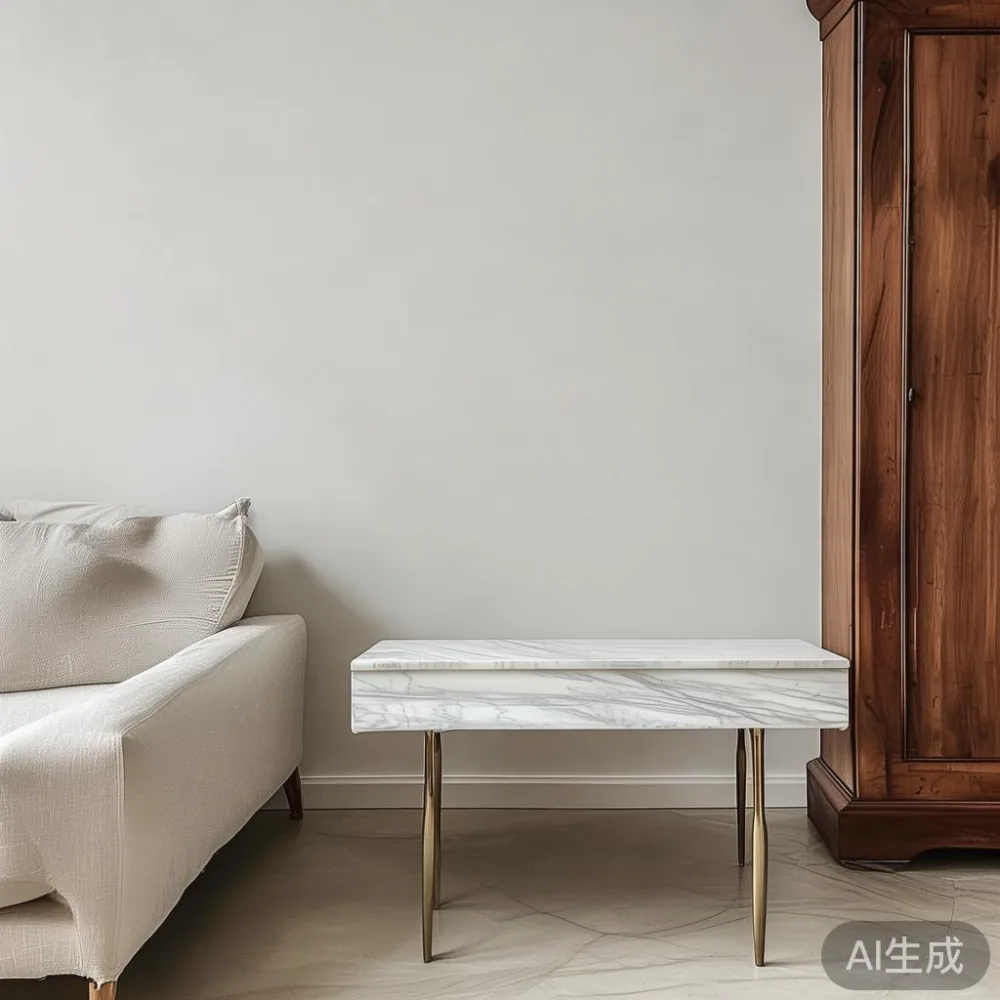
This is the question that pushes many homeowners toward mixed-material pieces. A marble table is dimensionally stable across humidity swings — a 1.4 m sintered stone or natural marble top will not cup, warp, or shrink when the RH climbs from 55% to 85%. The catch is that marble moves with temperature, not moisture, and the substrate beneath the stone still matters. Most quality marble furniture uses an MDF or plywood substrate at 8–10% MC to back the stone; if that substrate is skipped or replaced with soft rubber, the top can develop stress fractures within a year. The stone itself responds to thermal swings — a cold marble tabletop hit by a warm serving dish can hairline-crack — but it is in effect indifferent to Singapore's humidity.
For that reason, hybrid pieces — a solid ash bed frame paired with a marble-topped nightstand, or a French-inspired marble console flanking a solid wood sofa — tend to age most gracefully in local homes. The wood provides warmth and acoustic softness; the marble provides a humidity-stable surface for daily use.
Which wood species survive a Bedok condo best?
Not all solid wood behaves the same way. Below is a comparison based on our factory's 16 years of export data and post-delivery feedback from customers in Singapore, Kuala Lumpur, and Jakarta — three markets with similar humidity profiles.
European oak (including French oak): Tangential shrinkage around 0.8–1.0% per 10% MC change. Dense (680–750 kg/m³), takes hardwax oil well, ages to a warm honey tone. The standard choice for designer French provincial furniture collections and most of our dining tables. Tolerates Singapore air-conditioning well when dried to 8–10% MC.
American white oak: Slightly higher tangential shrinkage (around 1.0–1.2%), similar density, often used for light-luxury and American light luxury pieces. Acceptable for bedroom suites when conditioned properly.
European beech: Tangential shrinkage around 1.1–1.3%, very dense (700–730 kg/m³), pale colour. Common in Scandinavian and modern light luxury sideboard designs. More responsive to swings — best kept in fully air-conditioned rooms.
Rubberwood: Tangential shrinkage around 1.2–1.5%, density around 560–640 kg/m³. Budget-friendly but moves noticeably across seasons.
Walnut (American black): Tangential shrinkage around 0.9–1.1%, density 600–660 kg/m³. Excellent dimensional stability but at a price point well above oak in Singapore (expect SGD 2,400–3,800 for a queen bed frame).
Teak (Burma/plantation): Tangential shrinkage around 0.7–0.9%, density 630–720 kg/m³. Naturally oily, very stable — the traditional Southeast Asian choice for doors and window frames, and increasingly for outdoor-grade dining tables on balconies.
For a typical Tampines or Bedok bedroom suite — bed frame, two nightstands, and a 6-door wardrobe — oak delivers the strongest combination of stability, repairability, and price. For a balcony-facing dining table, teak is the safest bet.
Can I put a designer French provincial wardrobe next to my bathroom door?
A real customer question, and a common one. The rule of thumb I give in our showroom is to keep any solid wood piece at least 1.5–2 metres from a wet bathroom door, and never within 60 cm of an exterior wall that may wick moisture. Beyond that buffer zone, a properly dried designer French provincial wardrobe will hold shape. Inside the wardrobe, leave the rear panel 20–25 mm short of the wall so air can circulate; this prevents the back panel from absorbing wall moisture and bowing inward — a fault that ruins more wardrobes in Singapore than warping ever does.
For homeowners working through how to style European wardrobe in apartment layouts, the same buffer rule applies whether the wardrobe sits in a 3-room BTO in Punggol or a 1,200 sqft condo in the Bedok Reservoir area. A 2.4 m tall, 2.0 m wide, 60 cm deep French provincial wardrobe typically weighs 180–220 kg fully assembled; the lift in most HDB blocks accommodates that weight, but the corridor turning radius at the lift lobby is often the real constraint — measure 1.8 m wide × 2.0 m deep for the lift car, and 1.2 m for the corridor turning circle, before ordering anything over 2.2 m tall.
The post-modern light luxury category and humidity — what changes?
Post-modern light luxury pieces — think curved-edge consoles, fluted marble-topped nightstands, and mixed-material vanities — introduce new substrates that react differently to humidity. Many of these designs pair an MDF inner core with a thin solid wood veneer and a marble or sintered stone top. MDF itself is dimensionally stable below 65% relative humidity but swells permanently above 80% — which means a post-modern light luxury sideboard left in a consistently damp corner will irreversibly bloat along its bottom edge within 9–15 months. The fix is the same as for solid wood: keep the room between 50% and 65% RH, and never let standing water sit at the base.
A modern light luxury sideboard built on a birch plywood substrate — rather than MDF — has far better moisture resistance and is the safer pick for dining spaces that open onto a balcony door. Plywood can tolerate short humidity spikes up to 85% RH without permanent damage, which is why we specify it for the carcasses of all our post-modern light luxury pieces, even when the visible panels are solid oak or walnut.
What about under-SGD-2,000 industrial furniture — does budget mean more warping?
Industrial furniture under 2000 Industrial furniture pieces sold in Singapore often look identical to mid-range options, but the kiln-drying is the giveaway. A sub-SGD-1,800 industrial dining table is almost certainly built from boards dried to 12–16% MC, which means it will arrive already shrinking by the time the air-con reaches it. The first 90 days are the highest-risk window: the table shrinks, joints loosen, and the owner assumes the wood is "faulty." It is not faulty — it was simply dried to the wrong EMC for an air-conditioned home. Spending an extra SGD 600–900 for a table dried to 8–10% MC buys you the next decade of stability. For households comparing the under 2000 Industrial furniture segment against mid-tier imports, that MC specification is the single most useful differentiator.
How do I handle delivery into a HDB flat without damage?
Singapore delivery adds two specific risks: tight lifts, and monsoon-season rain between the lorry and the door. We schedule deliveries for the morning slot whenever possible, wrap every solid wood and marble furniture piece in breathable cotton blankets (never plastic, which traps condensation against the finish), and time the carry-in so the piece spends less than 90 seconds exposed to outdoor air. For a 6-door wardrobe, the assembled weight of 200 kg usually requires three delivery crew — two for stair climbs if the lift is unavailable, and one to spot the top during tight corridor turns. Our standard delivery fee is SGD 80 for HDB ground floors and SGD 140 for upper floors without direct lift access, waived on orders over SGD 2,800. Marble tables over 80 kg are transported as a top-plus-base split to reduce handling risk and re-assembled in the room.
For clients in newer Punggol and Sengkang BTOs with 1.0 m × 1.4 m lift cars, we measure the lift in advance and, where needed, deliver the side panels flat-packed. The MIDHILL TV console range, for example, ships as two pre-joined halves with the marble top in a separate crate, then is assembled in the living room in under 25 minutes.
What daily care keeps a solid wood wardrobe stable for 20 years?
Three habits cover 90% of moisture-related problems:
1. Run a dehumidifier or air-con to keep the room between 50% and 65% RH. A SGD 180 dehumidifier running four hours a day costs roughly SGD 12 a month in electricity — cheap insurance for an SGD 4,000 wardrobe.
2. Wipe spills within 10 minutes. Standing water on a solid oak surface for more than 30 minutes can raise the surface MC by 3–4 points and cause a visible ring that takes months to fade.
3. Re-oil the high-touch surfaces every 18–24 months. A 250 ml tin of hardwax oil costs SGD 28 and covers a 1.6 m dining table. Apply with a lint-free cloth, leave 20 minutes, buff off. This restores the moisture barrier without building a plastic film.
If you are sourcing the best Japandi wardrobe for 2026, prioritise pieces with traditional frame-and-panel construction (rather than slab doors) and mortise-and-tenon joinery — both of which allow natural wood movement without splitting. The same principle makes a French-inspired marble console or a solid wood sofa frame survive decades of monsoon cycles.
Does MIDHILL offer refinishing, that supports long-term humidity care?
Yes — refinishing is built into the way we ship. Every piece leaving our Foshan factory comes with a 10-year structural warranty against joint loosening and frame cracking under normal household humidity (defined as 45–70% RH). On top of that, customers can send any piece back to our regional service partner in Singapore for a paid refinish at any point — typical cost is SGD 280–480 for a dining table, including collection, re-sanding, re-oiling, and return delivery within 14 working days. For families who want to keep an heirloom-quality solid wood sofa or bed frame for two or three decades, that refinishing path is what makes the long-term cost of ownership genuinely reasonable.
If you are still comparing options, browsing any credible top 10 French provincial furniture list will surface the same handful of oak-using makers — and the same handful of questions about humidity, lift access, and warranty. The right answer is rarely the cheapest or the most expensive; it is the maker who dries to 8–10% MC, builds with plywood carcasses where appropriate, and stands behind refinishing for the long haul.
What's the realistic lifespan of solid wood furniture in Singapore?
For a properly dried oak or walnut piece, kept between 50% and 65% RH, and refinished every 15–20 years: 30–50 years is normal. Our factory's records show the average service life of an MIDHILLed dining table in Singapore homes is now 22 years and climbing, with several original 2009 pieces still in active use across Tampines, Bukit Batok, and Marine Parade. Marble components often outlast the wood substrates beneath them — a sintered stone top from 2012 can be re-mounted onto a new base if the original wood fails.
That lifespan depends almost entirely on three numbers: the kiln-dried MC of the wood when it left the factory, the average RH of the home it lives in, and the regularity of surface maintenance. Get those three right, and a solid wood or marble furniture piece is one of the few household purchases that genuinely becomes an heirloom rather than a write-off. Get them wrong, and even the most expensive designer piece will show distress within the first three monsoon seasons.