Veneer vs. Solid Wood Costs: 5-Year Comparison
Choosing a dining table, bed frame, wardrobe, or nightstand for a Tampines HDB flat or a Bedok condo is rarely just about the price on Day 1. It is also about how the piece handles humidity, frequent daily use, small lifts, shared corridors, and the need to move or resell it later. A veneer dining table may look identical to solid wood on delivery day, yet the two materials can produce very different five-year costs.
This comparison uses indicative Singapore retail prices in SGD, excludes GST because GST treatment depends on the seller and transaction, and assumes one household using the furniture normally. For a fairer comparison, I treat veneer as a quality wood veneer over a stable engineered core and solid wood as kiln-dried hardwood with visible joinery. Real repair outcomes vary, so the figures should be used as planning ranges rather than guarantees.
How much does veneer furniture cost over five years compared with solid wood?
For a typical dining setup seating 6 people, a good-quality veneer dining table might cost S$1,200. A comparable solid oak dining table might cost S$2,400. Over five years, the veneer table could require one edge-band repair at S$120 and one refinishing service at S$250, producing a total of S$1,570 before GST. The solid table may need an average of S$180 in minor scratches, one adjustment at S$90, and no full refinishing during that period, producing a total of S$2,670.
That simple comparison suggests veneer can cost about S$1,100 less. However, the result changes if veneer is damaged at a weak point. Replacing a delaminated tabletop section can cost S$350 to S$550, while refinishing a solid wood top might cost S$350 to S$650. If a low-cost veneer table suffers a S$450 structural repair after four years, its five-year outlay reaches S$1,950.
The core issue is not whether one label is always cheaper. It is where the money goes. Veneer concentrates cost in the surface sheet and core. Solid wood distributes cost across the legs, rails, joints, and top, so localised damage may be easier to repair.
For Singapore, I would also include transport constraints in the calculation. A dining table weighing 72 kg may need two movers and a private van. That could add S$120. A 95 kg solid table may need three movers and a larger vehicle, adding S$220 to S$320. A flat with a 90 cm lift opening and an 110 cm turning corridor may require the table to be carried in sections.
What is the realistic five-year cost of a solid wood sofa?
A three-seat solid wood sofa with a fixed timber frame and upholstered cushions may cost S$3,200 in Singapore. A comparable upholstered frame made with veneer may cost S$2,100. The cushions, fabric, and foam should be comparable in both cases so the material comparison remains focused.
My colleague in the furnishing trade tested a veneered side panel last month in a sample unit. After 18 months of use near an air-conditioned bedroom door, the panel remained stable, but the exposed edge showed a visible 2 mm lifting line after a minor knock. The solid oak side panel in the same unit took the knock without lifting. That is one practical observation, not a universal rule, but it explains why edge construction matters.
Over five years, allow roughly S$220 for fabric cleaning and seam repair on the solid wood sofa, plus S$140 for a hinge or leg alignment adjustment. Total expected cost: about S$3,560. For the veneer sofa, allow S$180 for cleaning, S$120 for a small repair, and S$300 for one frame-section replacement. Total: about S$2,700.
The solid wood sofa therefore costs about S$860 more across five years in this scenario. Yet its resale and moving value may be stronger. A sound solid wood frame can be reupholstered for S$900 to S$1,400, effectively extending its life. Veneer panels can be replaced only if the original veneer and core specification remain available; otherwise, the repair can become disproportionate.
Buyers asking how to choose Japanese sofa should pay more attention to the base frame than to the cushion label. Low seating, firm support, and compact proportions suit many Punggol and Tampines homes, but a slim Japanese-style frame still needs solid timber or a well-engineered core that will not twist. Ask the seller for the frame material, not merely the decorative outer layer.
How much do bed frames, wardrobes, and nightstands cost after five years?
A queen solid wood bed frame might cost S$1,600, while a comparable veneer frame might cost S$950. For a queen bed, assume movement and a minor joint repair of S$120 on the solid frame and S$180 on the veneer version. The estimated five-year totals are S$1,720 and S$1,130 respectively.
A 2-door solid wood wardrobe may cost S$2,200. A comparable engineered-wood wardrobe with wood veneer may cost S$1,300. Hanging rails, hinges, and drawer runners require maintenance in either category. Allow S$220 over five years for hinge adjustments in both cases, S$150 for veneer particle-board repair if moisture exposure causes swelling, and S$0 to S$120 for solid wood joint work. The resulting totals are about S$2,420 for solid wood and S$1,670 for veneer.
That S$750 difference becomes significant in HDB interiors, where built-in storage can consume 180 cm of wall width. A taller 210 cm wardrobe adds around 35 kg, while a wider 240 cm unit can weigh 95 kg. Before buying, measure the lift door, corridor turn, bedroom doorway, and stair landing—not only the empty wall.
For someone searching for the best French provincial wardrobe for 2026, the carved details and curved posts matter, but panel movement and moisture resistance matter more over time. French provincial styling works well in a master bedroom, yet a compact 120 cm two-door version may be more practical than a 150 cm unit in a narrow condo corridor.
A solid wood nightstand might cost S$420 against S$280 for veneer. Include drawer-runner adjustment at S$40 for each type. The solid nightstand reaches about S$460 over five years, while veneer reaches S$320. The price gap is modest, so buyers who prefer a hand-finished grain and repairable construction may find solid wood the more sensible choice here.
Does solid wood really cost less when repairs, refinishing, and resale are included?
Not always. Solid wood usually costs more at purchase, but it can be sanded, patched, and refinished repeatedly. MIDHILL offers lifetime refinishing on its qualifying solid wood products, which can reduce future appearance-related costs. This does not mean solid wood furniture is free to maintain; moving, deep cleaning, and component replacement still cost money.
For this five-year model, I use the following figures:
Veneer dining table: S$1,200 purchase + S$120 edge repair + S$250 refinishing = S$1,570.
Solid wood dining table: S$2,400 purchase + S$180 scratches + S$90 adjustment = S$2,670.
Veneer bed frame: S$950 purchase + S$180 maintenance = S$1,130.
Solid wood bed frame: S$1,600 purchase + S$120 maintenance = S$1,720.
Veneer wardrobe: S$1,300 purchase + S$220 adjustment + S$150 repair = S$1,670.
Solid wood wardrobe: S$2,200 purchase + S$220 adjustment = S$2,420.
Add delivery if the seller does not include it. MIDHILL provides free shipping above US$350, but Singapore buyers should confirm the local quoted freight, lift booking, and doorstep-versus-room placement terms. A Singapore delivery charge of S$120 is reasonable for a dining table; room placement inside a tower may cost S$180 more if the lift reservation is not included.
Expected resale value should be viewed separately from ownership cost. Assume a used solid dining table might retain 45% of its original price after five years, while a good veneer table retains 25%. On the figures above, that is about S$1,080 retained value for the solid table and S$300 for the veneer table. Subtracting retained value from five-year cash costs gives S$1,590 for solid wood and S$1,270 for veneer—a narrower S$320 difference.
Which material is more suitable for Singapore humidity?
Both can work in Singapore, but the construction details matter. Keep relative humidity around 40% to 65%, avoid direct air-conditioner airflow, and wipe spills within 15 minutes. Solid oak and ash are less vulnerable to core swelling than many engineered panels, although their movement can still cause cracking if moisture changes are extreme.
Veneer is a thin layer of real wood, often around 0.6 mm to 2 mm, bonded to an engineered core. It can be stable when made well. The weak points are edges, seams, and drilled areas where moisture enters. Quality veneer furniture should use sealed edges, balanced construction, and a core designed for the product’s load.
Solid wood expands and contracts across the grain. A dining top may move 3 mm to 6 mm across a 180 cm width over seasonal humidity changes. That is normal and should not be confused with a failed joint. A round solid dining table may move about 2 mm to 4 mm, while a rectangular engineered table with a veneer skin may move less.
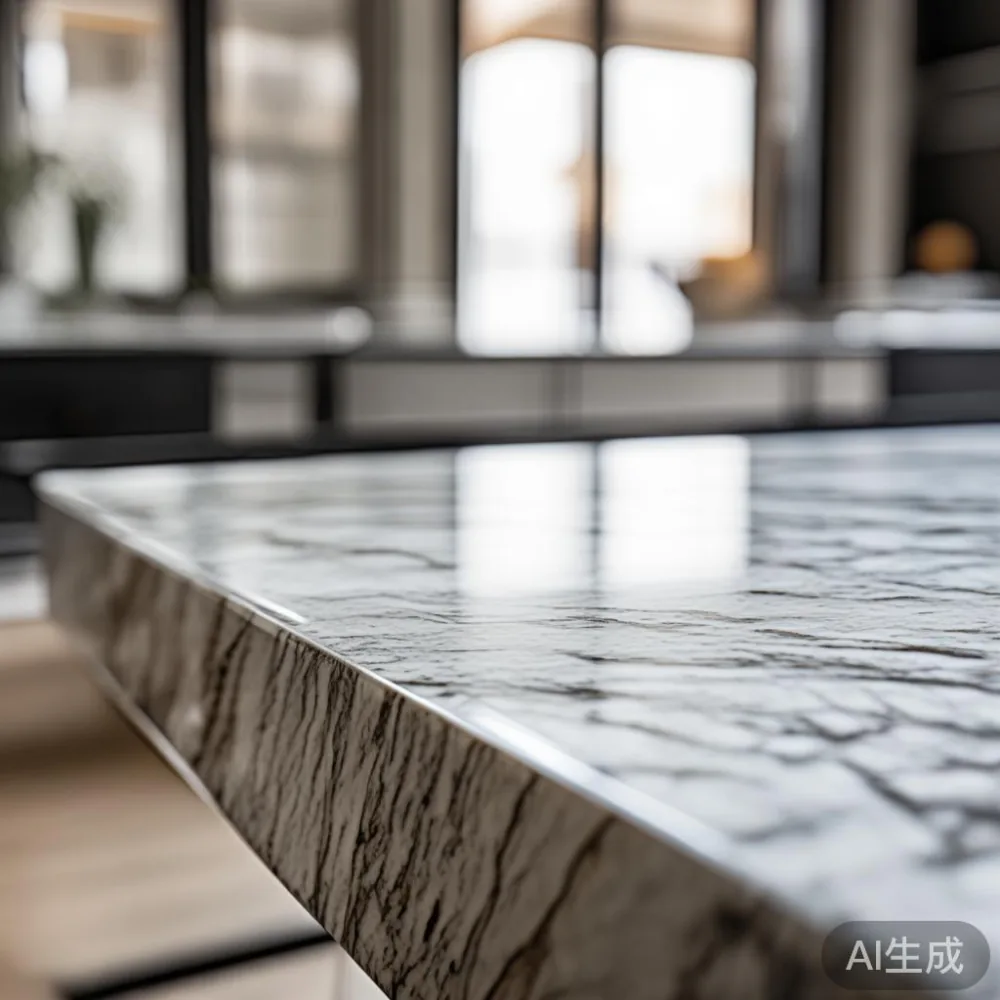
Marble furniture introduces a different material decision. A marble table may weigh 65 kg for a 120 cm round top and 140 kg for a 200 cm rectangular version with a stone base. Marble resists heat and scratches that would mark wood, but it is vulnerable to impact and needs careful handling. In lift lobbies, protect corners and confirm that a 90 cm lift door can accept the packaged dimensions.
Marble furniture also suits the post-modern light luxury language used in many new Singapore condos: clean stone planes paired with warm timber, slim profiles, and restrained brass details. It can sit beside a solid wood dining table or bed frame without feeling visually unrelated.
How should you compare a five-year quote from a Singapore furniture seller?
Ask for the same information on both products. Request the timber species, veneer thickness, core material, joint type, finish system, drawer hardware, weight, and warranty. A vague claim of “wood” is not enough. Solid ash, solid oak, and solid rubberwood have different densities, hardness, and price points.
For a solid wood sofa, bed frame, dining table, wardrobe, or nightstand, ask whether “solid wood” covers the complete structural frame or only selected visible parts. For marble furniture, ask whether the top is natural marble, porcelain, or another engineered stone, and confirm the base weight and installation method.
International design references can help with style, but the specification still needs to suit local conditions. Searches for for sale Modern light luxury furniture or modern Italian light luxury furniture may return useful material and finish references. A project combining French provincial for hotel details with Italian light luxury for hotel proportions can translate well into a home, provided the doors, lifts, and corridors can accept the dimensions.
One practical purchasing method is to create a five-year spreadsheet with 6 columns: purchase price, delivery, maintenance, repair, refinishing, and expected resale value. Enter realistic figures rather than zero for maintenance. If the two products are within S$300, choose the construction that is easier to repair locally. If the gap is more than S$700, the lower-cost option often gives more immediate value, provided its edge and core specification is sound.
For MIDHILL wardrobe enquiries, request the carcass and door material separately, including the interior finish and hardware model. For a dining table, ask for a sample of the finished surface and the assembled weight. For a nightstand, confirm the internal drawer dimensions, which often matter more in Bedok and Tampines bedrooms than external styling.
What should you buy for a Tampines, Bedok, or Punggol home?
For a compact HDB dining area, a 140 cm veneer dining table may fit where a 180 cm solid table makes circulation uncomfortable. Choose rounded corners if a child’s play area is nearby, and request a stable underframe with a 70 kg or greater stated load capacity. The five-year saving can be around S$700 to S$1,000, while the footprint remains manageable.
In a Punggol condo with full-height glazing, solid wood helps control seasonal movement, while veneer can be practical for wardrobe doors and bed frames. Measure the balcony threshold at 90 cm and the hallway corner at 110 cm. A 180 cm wardrobe will not fit through a 90 cm door unless tipped, and a solid frame may be too heavy to turn safely.
For Bedok families, a solid wood bed frame and veneer wardrobe can provide a balanced ownership profile. The bed is touched daily and benefits from repairable rails; the wardrobe can absorb budget through engineered construction. A marble table is better reserved for a defined dining zone or compact console because its mass makes frequent relocation difficult.
My practical recommendation is simple: use veneer where budget, weight, and a slim footprint dominate; use solid wood where the piece is a long-term focal point, frequently handled, or likely to be refinished. Check delivery dates, lift access, warranty coverage, and return conditions before payment. Allow 7 to 14 delivery days for Singapore orders, and retain the packaging until the furniture has been inspected for 3 days, subject to the seller’s stated return policy.
Across these five-year examples, veneer usually wins on immediate cash cost, while solid wood often offers greater repair flexibility and retained value. The wiser choice is not based on a material slogan. It is based on your room dimensions, household habits, local humidity, maintenance plan, and the clarity of the seller’s construction warranty.