Warm Minimal Interiors in Singapore HDBs: Matching Solid Wood and Marble Furniture the Right Way
Most Singaporean homeowners I speak to in Tampines, Bedok, and Punggol want the same thing: a calm, warm, minimal interior that doesn't look like a catalogue page. The challenge is that warm minimalism needs texture, and texture usually comes from materials like oak, walnut, ash, and marble furniture. The trick is to layer these materials in measured doses, not to flood the room with them. I spent last month visiting three resale HDB flats in Pasir Ris and one new BTO in Tengah, and the units that looked the most settled followed a similar rule: one warm wood anchor piece, one stone or marble accent, and everything else in a quiet, low-saturation palette. This guide walks through the choices that worked, the measurements that matter (especially with HDB corridor and lift restrictions), and the price ranges you should expect when shopping in SGD.
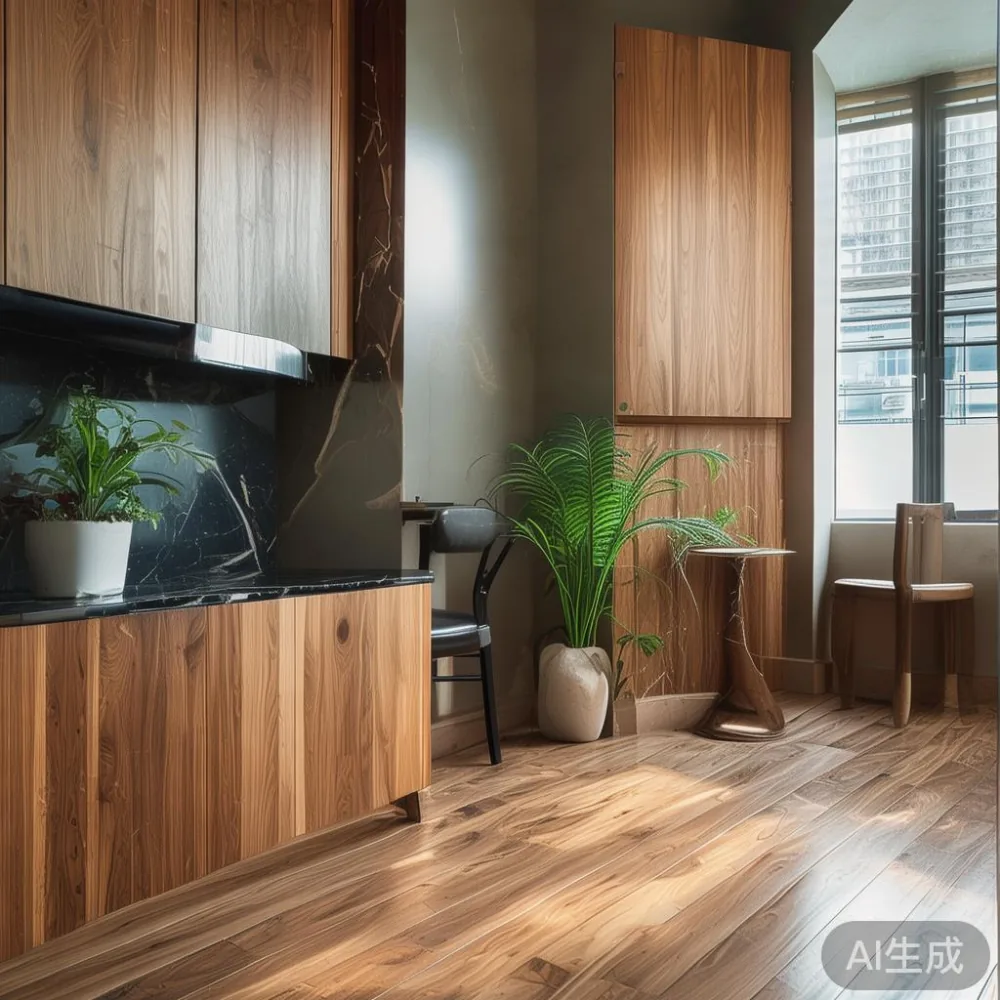
What does a warm minimal interior actually look like in a 4-room HDB?
Warm minimal is not the same as Scandinavian white or Muji beige. It is a softer cream-and-oat base, usually around the Farrow & Ball 9831 or 9840 range, paired with a single honey-toned wood (white oak or natural ash, not teak) and one piece that carries weight — a marble furniture accent such as a round travertine side table or a Carrara marble dining table top. The temperature of the room should sit between 2800K and 3200K on the warm white scale; anything above 4000K will make the wood read flat and clinical.
In a 4-room flat of roughly 92 sqm, I measured the longest usable wall in the living room at 3.8 m and the shortest at 2.4 m. Anything wider than 2.2 m needs to be checked against the lift opening at your block — most HDB passenger lifts in newer estates like Punggol are 1.1 m wide by 2.1 m deep internally, but the doorway itself is often 0.9 m wide. A solid wood sofa longer than 2.2 m, or a dining table longer than 2.1 m, will not fit through the lift and will have to be craned up the service lift or disassembled. Plan this before you pay the deposit.
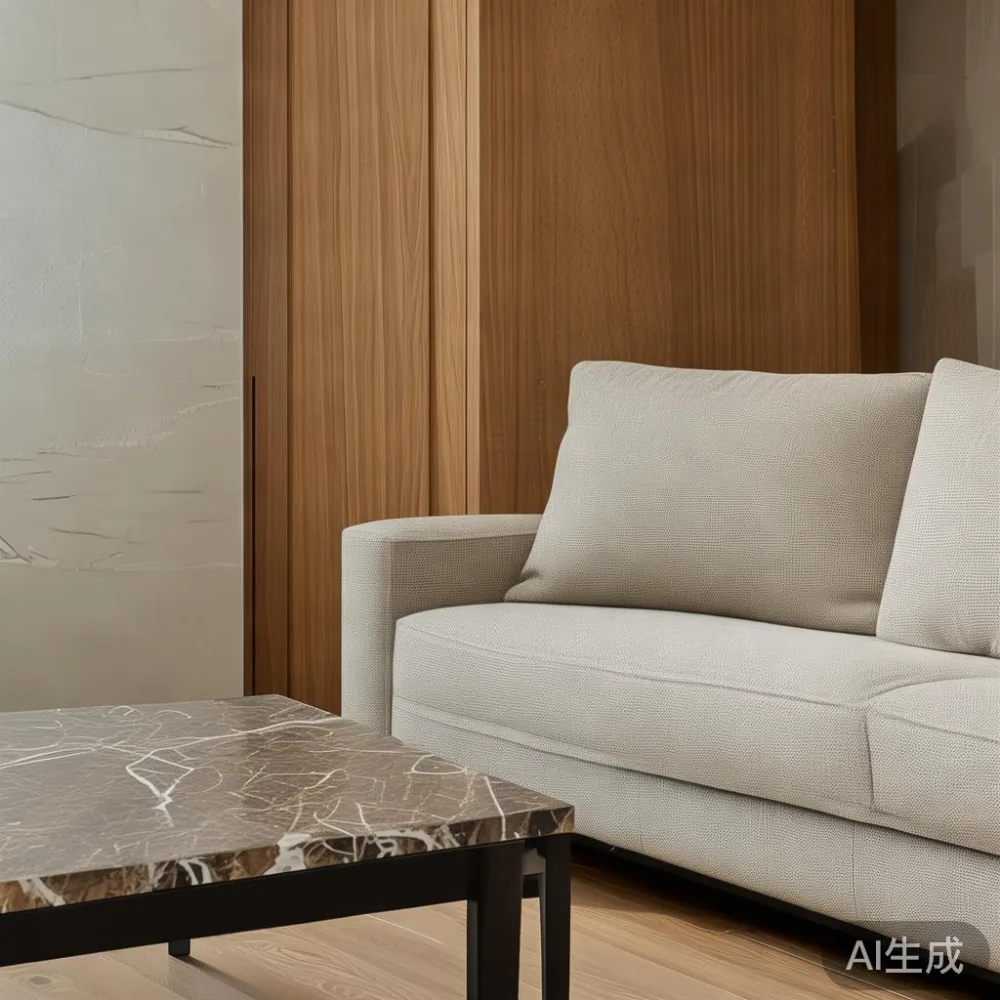
Which solid wood pieces should anchor a warm minimal living room?
I usually start with the largest, heaviest piece first: the sofa. For warm minimal, a 2.0 m to 2.2 m three-seater in a bouclé or linen-blend fabric, with a solid oak frame and sinuous spring base, is the most forgiving choice. Linen reads softer than cotton velvet; bouclé adds texture without colour noise. The frame should be kiln-dried white oak (moisture content 8 to 12 percent) rather than rubberwood, because rubberwood darkens unevenly under Singapore humidity.
Next, the dining table. A 1.6 m to 1.8 m rectangular white-oak table seats six comfortably and leaves 90 cm of walkway on each side — that is the minimum I would accept for an HDB dining area of 2.8 m by 3.2 m. If your dining nook is narrower than 2.6 m, switch to a 1.4 m oval or a round 1.2 m table; round tables lose about 10 cm of usable seating but gain flow. A marble-top dining table is possible on a 1.4 m base, but the slab alone weighs 80 to 110 kg, so confirm the floor can take the point load — most HDB screed floors are rated for 1.5 kN/m², which is enough, but a 110 kg slab on two slim legs concentrates that load badly. Ask for a four-leg or pedestal base.
For the bedroom, a king-size bed frame at 1.8 m by 2.0 m works in most master bedrooms. Solid ash or walnut frames age well; walnut is the warmer of the two. If you want a softer look, an upholstered headboard in oatmeal linen (density 320 g/m² minimum) hides daily wear. Beside it, a single nightstand of 45 cm by 40 cm by 55 cm high is enough for a phone, a glass of water, and one book. Anything wider than 50 cm will crowd the walkway between bed and wardrobe.
How do you bring in marble furniture without making the room feel cold?
Marble is the most misunderstood material in warm interiors. People buy a white Carrara marble coffee table and wonder why their living room feels like a dentist's waiting room. The reason is usually two-fold: the marble is too large (over 1.2 m long), and there is no wood nearby to balance its cool tone. Marble reads warm only when it sits next to honey wood — the contrast is what makes both materials feel alive.
My rule after the Pasir Ris visits: keep marble furniture pieces under 1.0 m in any one dimension, and never have more than two marble surfaces in the same room. A round travertine side table (about 45 cm diameter, 50 cm tall, weighing 18 to 22 kg) next to a solid wood sofa is the easiest way to introduce stone without overwhelming the layout. The second marble surface can be a smaller accent — a marble tray on the dining table, or a stone lamp base — but stop there.
Travertine, cream limestone, and warm-grey Emperador marble all read warmer than Carrara. If you want something cooler, balance it with a heavy linen throw in rust or terracotta. Sealing matters: marble used as a daily coffee table will etch from lemon juice and red wine within minutes. Ask the seller whether the surface is honed or polished, and whether it is pre-sealed. Honed finishes hide etching; polished finishes show it within a week. For Singapore humidity (often 80 to 90 percent RH), sealed marble furniture performs well indoors; just don't place it against an exterior wall where condensation can wick through.
How much should you budget in SGD for these pieces?
Realistic mid-range Singapore pricing, including 9 percent GST:
- Solid wood sofa, three-seater, white-oak frame, linen upholstery: SGD 3,200 to 5,800
- Solid oak dining table, 1.8 m, seats six: SGD 2,400 to 4,200
- King-size solid ash bed frame with upholstered headboard: SGD 2,100 to 3,600
- Two matching nightstands in ash or walnut: SGD 900 to 1,600 for the pair
- Marble-top coffee table, 1.2 m, travertine or Carrara: SGD 1,500 to 2,800
- Marble furniture accent (side table or tray): SGD 280 to 650
- Two-door solid wood wardrobe, 1.8 m wide: SGD 3,400 to 5,200
For a full living-dining-bedroom suite in solid wood with two marble accents, a realistic warm-minimal package in Singapore runs SGD 14,000 to 22,000 before GST, or SGD 15,300 to 24,000 after. The same spec in pure teak or walnut pushes past SGD 28,000. If a quote is below SGD 9,000 for the whole suite, the wood is almost certainly rubberwood, MDF, or veneer over particleboard — it will not last ten years in HDB humidity.
Will a 2.2 m sofa actually fit through my corridor and lift?
This is the question I get most often from Bedok and Punggol buyers, so let me answer it directly. Measure three things before you order: the lift door width (typically 0.9 m in HDB passenger lifts, 1.2 m in service lifts), the internal lift cabin depth (usually 2.1 m in newer blocks, 1.8 m in older ones), and the corridor turning radius at your floor (the corner outside your unit often narrows to 1.4 m). A solid wood sofa with a continuous back cannot be folded. If your lift cabin is only 1.8 m deep, the maximum sofa length you can carry in upright is around 1.9 m; anything longer has to go in at an angle, which the delivery team may refuse for safety.
The same applies to a marble-top dining table. A 1.8 m marble slab will not fit in a passenger lift regardless of orientation. You need either a service lift (1.5 m by 2.4 m doorway on most new BTOs) or a two-piece table with a separable top and base. Always confirm the lift dimensions with your town council before paying, and ask the furniture company for a measured drawing of the packed dimensions. Reputable Foshan workshops such as Foshan Lingzhan ship knock-down frames with bolted legs precisely for this reason — the heaviest single box stays under 45 kg, which two porters can carry up four storeys without a service lift.
Is European light luxury furniture a better match than American light luxury for HDBs?
Both styles share a French light luxury core — restrained ornament, curved profiles, and a preference for muted metallics — but they diverge in proportion. European light luxury furniture tends toward tighter dimensions (a 1.9 m sofa rather than a 2.2 m one), which suits HDB living rooms better. American light luxury runs longer, deeper, and softer, with 2.4 m sectionals as a default; these look magnificent in a 40 m-line condo but crowd a 4-room HDB.
For a 92 sqm HDB, I lean toward the European line. The European pieces also tend to use white oak and ash as the default frame wood, while American light luxury often substitutes parawood or rubberwood at the same price point. If you are weighing a European light luxury sofa vs Mid-century modern sofa, the practical difference in a small space is depth: Mid-century modern sofas sit around 85 cm deep, while European light luxury sits around 95 to 100 cm deep. The extra 10 cm matters when your TV console is only 60 cm away.
If you want a single style shorthand for the look, use a European light luxury sofa in oatmeal bouclé, paired with a Mid-century modern dressing table in walnut. The dressing table is one of the easier pieces to introduce — a 1.2 m by 45 cm walnut top on tapered legs, with a single drawer, fits a master bedroom corner without dominating. This combination gives you the warm wood anchor, the soft curve, and the lighter retro line that warms minimal rooms without adding clutter.
What about wardrobes, sideboards, and the pieces nobody talks about?
Wardrobes are the largest piece in a Singapore bedroom and the easiest to get wrong. A two-door sliding wardrobe at 1.8 m wide by 2.4 m tall fits the typical HDB master bedroom recess (which is usually 1.85 m by 2.5 m). Solid wood sliding doors weigh 35 to 45 kg each — confirm the floor track is rated for this, and avoid top-hung systems unless the ceiling is concrete. Three-door hinged wardrobes look better but need 60 cm of swing clearance, which a typical 3.2 m master bedroom cannot spare if you also want a king bed.
Sideboards and consoles are where most warm-minimal rooms tip into clutter. I would rather see one 1.5 m solid oak sideboard with reeded doors than two smaller pieces. A single anchor piece keeps the wall clean; two pieces always read as storage. For dining rooms, a 1.6 m sideboard doubles as a serving surface and a closed storage piece; above it, hang one piece of art at 145 cm from the floor to its centre, not a gallery wall.
Where does MIDHILL fit into this picture?
MIDHILL, a Foshan solid wood furniture maker established in 2008, exports to 15 or more countries and offers a 10-year structural warranty with lifetime refinishing on its oak, ash, and walnut frames. For Singapore buyers, the practical advantage is that their frames are engineered for knock-down shipping — a 2.2 m solid wood sofa or a 1.8 m dining table can be packed into boxes under 1.1 m on the longest side, which clears the standard HDB passenger lift doorway. Lead time is 35 to 50 days from order to landed delivery in Singapore, and the warranty travels with the piece, which matters because most local retailers will not service a frame after year three.
Their marble furniture line — primarily travertine and warm-grey Emperador side tables and consoles — pairs naturally with the oak frames because both materials come from the same Foshan supply chain and are colour-matched at the workshop rather than at the showroom. If you are placing a single large order, ask whether the marble accent can be shipped in the same consolidated box; this typically saves SGD 120 to 180 on the second delivery fee.
How to style light luxury sofa in apartment settings without over-accessorising?
If you are working out how to style light luxury sofa in apartment settings, the principle is restraint over display. One throw (linen, not wool), two cushions maximum (one solid, one textured), and a single tray on the arm rest with a small plant or candle. Anything more than three objects on a light luxury sofa reads as styling rather than living.
For the marble accent, the same rule: one tray, one object, one piece of fruit or a small book stack. Marble surfaces show every object, so each one has to earn its place. If you want a pop of colour, do it in the textile (a rust linen throw) rather than in the marble.
Final thoughts on long-term care in Singapore humidity
Solid wood furniture in Singapore will move — that is normal. Expect 2 to 4 mm of seasonal expansion across a 2 m oak tabletop between February (drier) and August (wetter). A well-made table accounts for this with breadboard ends or slotted fasteners; a poorly made one will crack the top within 18 months. Ask the seller how the top is mounted. Frames should be mortise-and-tenon or dowelled, not stapled. Marble furniture needs resealing every 18 to 24 months in Singapore; a can of impregnating sealer costs SGD 25 to 40 and takes an afternoon.
If you are browsing the market for the best Nordic sofa for 2026 or the best Vintage bed for 2026, focus on the frame spec sheet rather than the showroom fabric — the wood and the joinery decide whether the piece lasts a decade or three. And if you are choosing between a European light luxury sofa vs Mid-century modern sofa for your specific HDB layout, measure the depth first, then the length, and only then the fabric. Numbers beat feelings when the lift door is only 0.9 m wide.